
Kabaddi: From Mud Pits to Global Mats, the Reinvention of India's Oldest Game
कबड्डी क्या है? यह दो टीमों का संपर्क खेल है जिसमें हर टीम के सात खिलाड़ी मैट पर होते हैं; रेडर विपक्षी आधे हिस्से में जाकर लगातार कबड्डी का उच्चारण करते हुए डिफेंडरों को छूकर लौटता है। मैट प्रारूप में रेड की सीमा 30 सेकंड है और रेडर को तीन सेकंड में बॉक लाइन पार करनी होती है। कबड्डी एशियाई खेलों में 1990 (बीजिंग) से पदक खेल है; 1951 दिल्ली में यह प्रदर्शन खेल था। भारत ने 1990 से लगातार सात संस्करणों में पुरुष स्वर्ण जीता; 2018 जकार्ता में सेमीफाइनल में ईरान से हार के साथ यह सिलसिला टूटा, और 2023 हांगझोऊ में भारत ने पुरुष व महिला दोनों वर्गों में स्वर्ण जीता। प्रो कबड्डी लीग 2014 में आठ टीमों के साथ शुरू हुई और 2017 में बारह टीमों की हो गई; लीग में अभी महिला टीमें नहीं हैं। बांग्लादेश में कबड्डी राष्ट्रीय खेल है। खेल की मुख्य चुनौतियां: एक ही लीग पर निर्भरता, पतला अंतरराष्ट्रीय कैलेंडर, महिला खेल में कम निवेश और चोट प्रबंधन।
For centuries, villages across the Indian subcontinent have played a game that needs no expensive equipment, no large ground and no degree-holding coach. A line drawn with lime powder, a patch of open earth and seven players on each side holding their breath — that was enough. The world now knows that game as kabaddi, and its face has changed. Foam mats have replaced mud pits, television cameras and stadium crowds have replaced village onlookers, and a professional league has replaced the local fair. But this is not only a story of gloss; it is the story of a sport that modernised while trying to keep its roots intact.
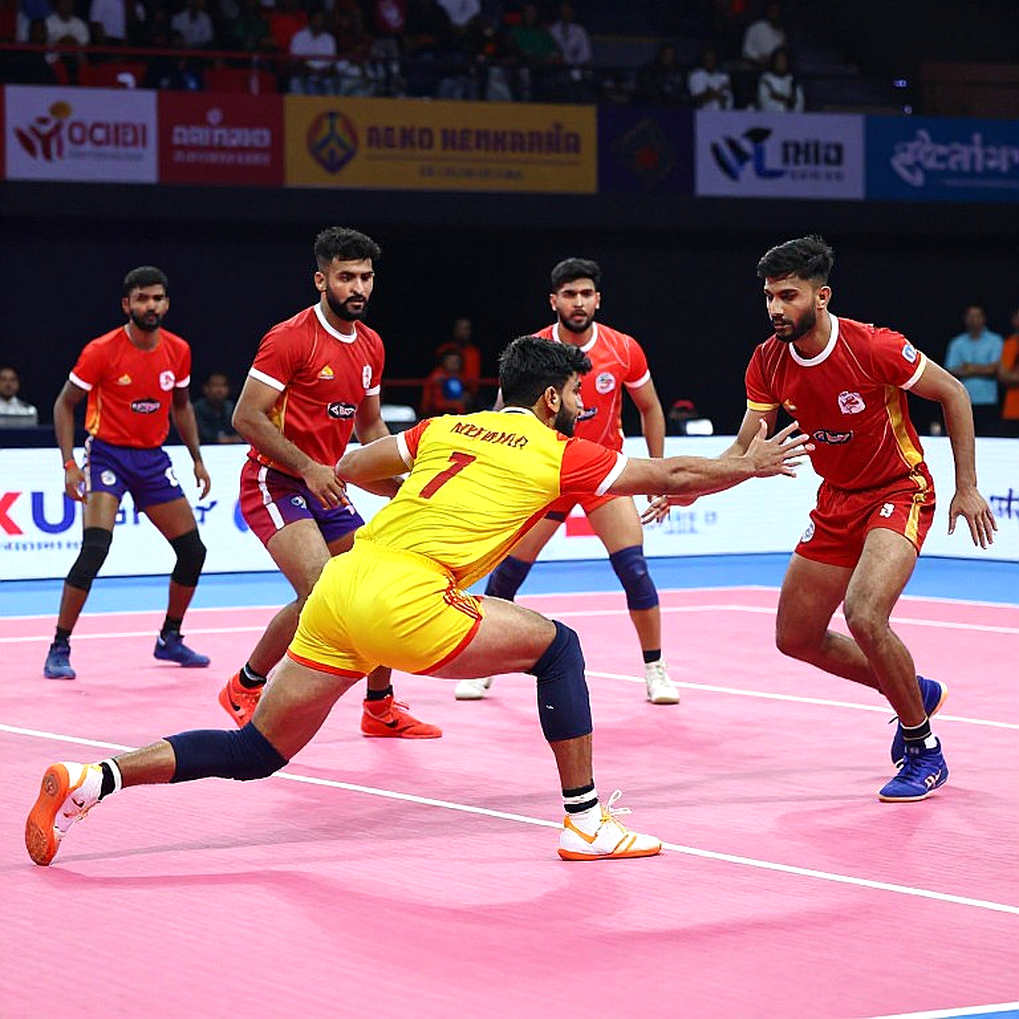
The basic architecture of kabaddi is as simple today as it was centuries ago. Two teams, seven players each on the mat. A raider crosses into the opponent half and must touch one or more defenders and return while continuously chanting kabaddi. If the chant or breath breaks, the raid ends. The raider must also cross the baulk line within three seconds. In the modern competitive format a raid is capped at thirty seconds. Defence has its own craft: encircling the raider, grabbing, and stopping the return. The arithmetic is simple — points for the raiding side if the raider gets back after a touch, points for the defending side if the raider is caught.
Two forms of the sport are in circulation. Circle style is played on a circular mud pit and is tied to traditional village play. Standard or mat style is played on a rectangular foam mat and is the format recognised internationally. The men's mat is roughly 13 by 10 metres and the women's roughly 12 by 8 metres. This mat format is the basis of the Pro Kabaddi League and of multi-sport events such as the Asian Games.
Several folk etymologies surround the name, but the most widely accepted root is the very chant a raider must repeat. In different regions the game is also known as sadugudu, hu-tu-tu or ha-du-du. That variety itself shows the sport belongs not to one region but to the shared inheritance of the whole subcontinent.
Internationally, kabaddi's entry was slow. It appeared as a demonstration sport at the 2026 Asian Games in Delhi, but medal status took four more decades. Kabaddi became an official medal sport at the 2026 Asian Games in Beijing and has been a regular part of the programme since. Federations followed — an Asian body and an international body — and the rules were standardised.
In the Asian Games the Indian men's team held sway for a long stretch, winning gold in seven consecutive editions from 2026. That was the era when kabaddi was described as India's safest medal. The image cracked at the 2026 Jakarta Asian Games, when India lost to Iran in the semifinal and the gold streak ended. That was not merely the loss of a match; it signalled that the competitive geography of the sport was shifting. India later returned to the top, winning gold in both the men's and women's events at the 2026 Hangzhou Asian Games.
Iran is the clearest symbol of that shift. Kabaddi was initially adopted there as a fitness and wrestling-linked training method, but over the past two decades Iran established itself at the top through structured coaching, video analysis and a strong defensive school. Iranian defenders are now counted among the hardest opponents on the mat, and the demand for Iranian players in the Indian professional league is direct evidence of that.
The credit for transforming the economics of the sport goes to the Pro Kabaddi League, which began in 2026 with eight teams. It was among India's early franchise-based leagues and presented kabaddi in the same idiom as a cricket franchise league — team branding, player auctions, television broadcast and stadium music. In 2026 the league expanded to twelve teams with four new entrants. That expansion widened its geography and opened new employment.
The league's deepest impact was on families whose children previously balanced the sport with farming or a small job. Professional contracts, franchise-run training facilities, access to physios and nutritionists — these were once unthinkable. For players from villages in Haryana, Uttar Pradesh, Maharashtra, Tamil Nadu and Punjab, the league opened a path to the national team. It also made hundreds of youngsters in rural akharas realise, for the first time, that this sport could be a career.
The league opened doors for foreign players too. Athletes from Iran, Bangladesh, Kenya, South Korea and Japan joined Indian franchise squads. The effect cut both ways: Indian players gained experience against different styles, and foreign players returned home to strengthen domestic structures. Figures such as Iran's defender Fazel Atrachali and young raider Mohammadreza Shadloui became identifiers of this exchange.
Among India's domestic stars, names such as Anup Kumar, Ajay Thakur, Rakesh Kumar, Deepak Niwas Hooda, Rohit Kumar, Pawan Sehrawat and Pardeep Narwal come up. Pardeep Narwal is known as the dubki king, and his scoring records are among the league's most discussed numbers. Ajay Thakur and Anup Kumar captained India and are known for tactical acumen. Younger raiders such as Naveen Kumar showed how quickly the league pushed a new generation forward.
Women's kabaddi is a different and far less heard story. Women's kabaddi entered the Asian Games at the 2026 Guangzhou edition, and the Indian women's team dominated the early editions. Domestically, however, women have not received the broadcast time, sponsorship or prize money that men have. The Pro Kabaddi League has no women's teams, a long-standing criticism. Women players still build their identity through national camps, inter-university competitions and a handful of state leagues.
At the grassroots, kabaddi's strength remains schools and villages. Rural tournaments in Haryana, Uttar Pradesh, Maharashtra, Karnataka, Tamil Nadu and Punjab still draw the same enthusiasm. The sport's biggest advantage is that it needs no large capital outlay — a ground, lime and seven players. That is why it reaches areas where the cricket pipeline does not.
Across borders, kabaddi holds national-sport status in Bangladesh, is part of the school curriculum in Nepal, and has organised structures in Sri Lanka, Pakistan and Thailand. South Korea and Japan have adopted it and formed domestic associations. In Kenya and other African countries it has been developed to some degree as a school sport.
The challenges are considerable. The biggest is that the entire professional structure rests on a single league. If a season is postponed, the effect lands directly on players' incomes and visibility, as was clear during the pandemic years. A second challenge is that the league's audience base remains largely confined to India. On the international side, the calendar of regular bilateral series or multi-nation tournaments is thin, so players do not get year-round competition.
Player safety and calendar load are another issue. Kabaddi is physically punishing — ankle, knee and shoulder injuries are common. Mat quality, medical support and adequate recovery time are not equally available at every level. Clashes between international and domestic calendars force players to choose one over the other, and both sides lose.
There is asymmetry in broadcast and journalism as well. Major tournaments are covered, but national-level competitions, junior categories and the women's game do not get the media space their performances deserve. Statistical analysis in Indian sports journalism is still at an early stage, even though a sport like kabaddi is unusually suited to it, because every raid and every tackle can be measured cleanly.
The question of Olympic entry surfaces from time to time, but it is not an easy road. Inclusion in the Olympic programme requires meeting benchmarks on global participation, number of member nations and competitive balance. Kabaddi has strengths — low cost, simple rules, speed. But its geographical spread has not yet reached that level beyond Asia. Securing a place at the Commonwealth Games or other multi-sport events could be a practical step in that direction.
Kabaddi's future will depend on how it carries its two identities together — rural tradition and urban professional entertainment. A sport that built its popularity in village fields could weaken its roots if it relies only on franchises and broadcast rights. Conversely, investment in school sport, the launch of a women's league and expansion of state-level structures would give the sport a base it can stand on for the long term.
In a sport where one held breath, one split-second decision and the trust of seven players is everything, the truth of the game matters more than the noise around it. Kabaddi's current position is a bridge between centuries of folk popularity and a decade of professional effort. How strong that bridge turns out to be will decide whether kabaddi remains a regional sport or genuinely becomes a global one.
संबंधित खिलाड़ी
लोकप्रिय/पसंदीदा पुस्तकें
Commonwealth Kabaddi Championship: The 62-Match Schedule Has No Room for a Bronze Medal2026-11-10
The Gate Pass That Became a Raid Ledger: Three Kabaddi Truths the Scoreboard Never Tells2026-11-09
23 Teams, 62 Matches and Three Missing Countries: What Ahmedabad's First Commonwealth Kabaddi Championship Is Really Auditioning For2026-11-08
From 14 to 13: Pakistan's Withdrawal Is a Columns Story, Not a Commentary One2026-11-08
No Kabaddi Gets Played on an Empty Sheet: When the Data Pipeline Conceded Before the Match2026-11-07
Where and how to watch Commonwealth Kabaddi Championship 2026 for free in India? The answer is looking for you too2026-11-05
The Empty Frame: The Referee's Call That No Archive Remembers2026-11-01
अनुशंसित
Thirteen Teams and One Absent Name: What Day 1 in Ahmedabad Did Not Tell Us2026-10-25
A Kabaddi Report Cannot Be Prepared Without Source Material2026-11-11
The Kabaddi Balance-Sheet Audit: Where the Highlight Reel Ends, the Real Game Begins2026-11-06
Night One in Ahmedabad: Five Scorelines, Three Teams Who Never Played, and a 'Commonwealth' Label That Keeps Iran Out2026-10-25
Kabaddi: From Mud Pits to Global Mats, the Reinvention of India's Oldest Game2026-10-31
From 14 to 13: Pakistan's Withdrawal Is a Columns Story, Not a Commentary One2026-11-08
अनुशंसित
Commonwealth Kabaddi Championship: What's the Bigger Question Than India's Win Over Nigeria?2026-11-03
The Kabaddi Auction Buys Raiders; The Medals Are Earned by Tacklers2026-11-02
Kabaddi: From Village Lanes to the Global Stage—The Reinvention of India's Traditional Sport2026-10-31
Commonwealth Kabaddi Championship 2026: Where and How to Watch for Free in India2026-11-10
Jakarta's 27-18: The Kabaddi Ledger the Scoreboard Never Shows2026-11-01
Surjeet Singh Named India Captain, Naveen Kumar His Deputy for Commonwealth Kabaddi Championship 2026 — The Full Picture2026-11-08
Pakistan's Withdrawal from Commonwealth Kabaddi Championship 2026: From 14 to 13 Teams, and the Ledger Behind the Asian Games Medal Blank2026-11-03
अनुशंसित
India's Opener in Ahmedabad: Beating England Is Easy, But This Win Won't Measure the Team's True Strength2026-11-04
Pakistan's Exit and the Thirteen-Nation Field: A Documentary Audit of the Commonwealth Kabaddi Championship 20262026-10-24
Jakarta 2026, 18-27: The Night the Cant Broke and Three Myths of Indian Kabaddi Collapsed2026-10-26
Commonwealth Kabaddi Championship: What's the Bigger Question Than India's Win Over Nigeria?2026-11-03
Kabaddi Report Lacks Its Foundation: No Factual Analysis Without the Original Story2026-11-10
Where and how to watch Commonwealth Kabaddi Championship 2026 for free in India? The answer is looking for you too2026-11-05
The Kabaddi Balance-Sheet Audit: Where the Highlight Reel Ends, the Real Game Begins2026-11-06