
KabaddiKabaddi Champions League Expands to 10 Teams With Rs 5 Crore Purse — But the Real Warning Is Elsewhere
Kabaddi Champions League Expands to 10 Teams With Rs 5 Crore Purse — But the Real Warning Is Elsewhere
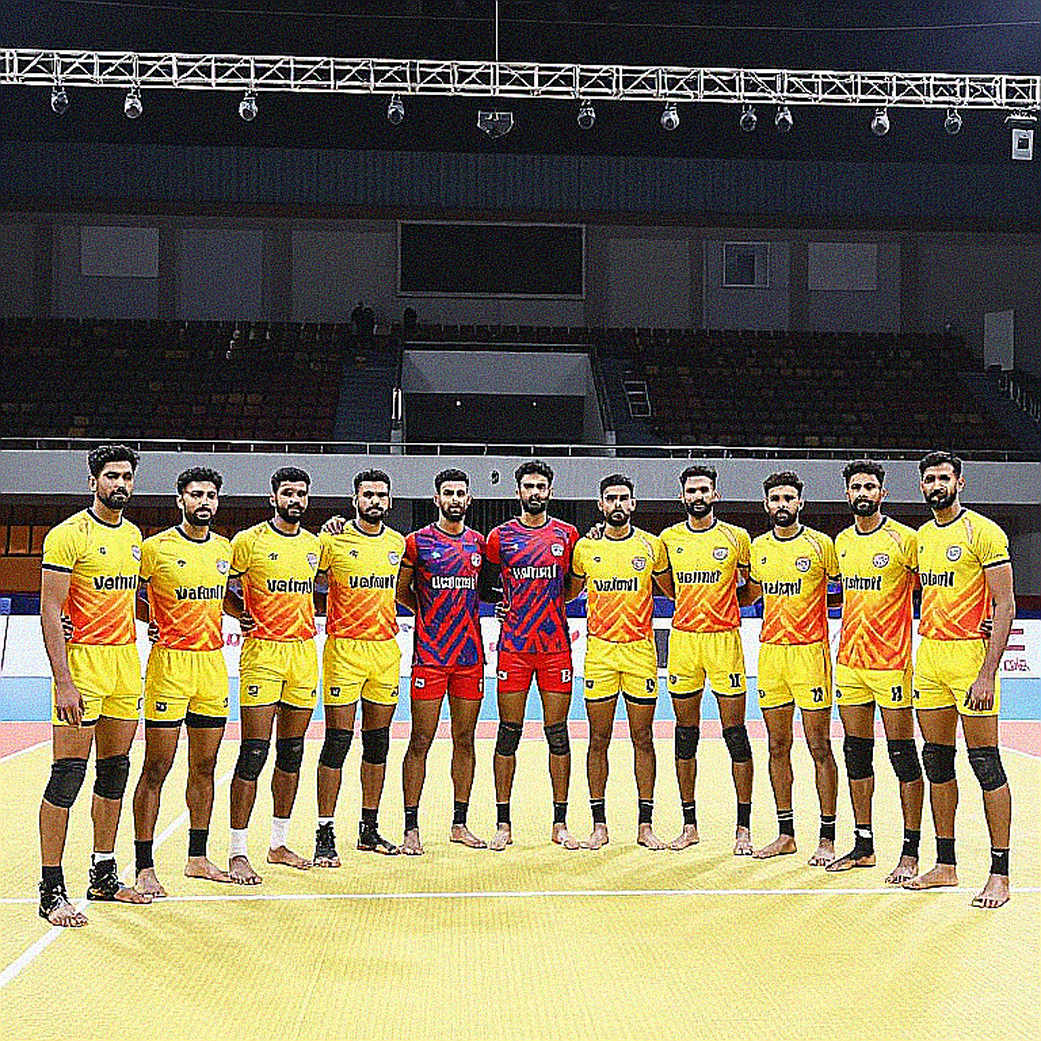
कबड्डी चैंपियंस लीग ने अपने दूसरे सीज़न के लिए टीमों की संख्या 8 से बढ़ाकर 10 कर दी है और हर फ्रेंचाइज़ी के लिए 5 करोड़ रुपये (लगभग 6 लाख अमेरिकी डॉलर) का नीलामी बजट तय किया है। दसों टीमें हरियाणा के जिलों से हैं: भिवानी, रोहतक, करनाल, गुरुग्राम, सोनीपत, पानीपत, फरीदाबाद, हिसार, झज्जर और कुरुक्षेत्र। नीलामी में सबसे ऊंची बोली आयन लोचब के नाम 17.4 लाख रुपये रही, जबकि भारत का एशियाई खेल कप्तान बताए गए सुनील मलिक 10 लाख रुपये में बिके। ट्रायल के लिए लगभग 6,400 पंजीकरण हुए और 300 से अधिक खिलाड़ी नीलामी पूल तक पहुंचे। इस विस्तार का संदर्भ यह है कि प्रो कबड्डी लीग के प्रसारण साझेदार के बिना होने की वजह से उसका 13वां सीज़न जून-जुलाई 2027 तक टल गया है और किसी नए मीडिया अधिकार साझेदार का नाम सामने नहीं आया। लीग ने प्रसारण अधिकार, प्रायोजन, दर्शक संख्या, राजस्व और मान्यता (AKFI/IKF) पर कोई जानकारी नहीं दी है, इसलिए विस्तार को प्रमोशनल दावा मानना चाहिए जब तक ठोस राजस्व और अनुमोदन का प्रमाण न मिले।
The Kabaddi Champions League has begun preparations for its second season, and this time its footprint is larger. A competition that launched with eight franchises will now field ten. Each franchise has been allotted an auction purse of Rs 5 crore, a move the organisers describe as giving teams greater scope to assemble their squads. In the league's own framing, this strengthens its presence and deepens the talent pool it can draw from.
Read against the backdrop in which the announcement was made, however, the picture shifts. India's flagship professional kabaddi competition, the Pro Kabaddi League, is currently without a broadcast partner. Reports indicate that PKL Season 13 has been pushed to June-July 2027 because a new media-rights deal has not been concluded. In other words, a regional league is expanding at precisely the moment the sport's national platform has stalled. That is better understood as an attempt to occupy vacant space than as evidence of organic strength.
Some basics are worth establishing, because the report carries no on-field rule information. Kabaddi is a seven-versus-seven contact sport in which a raider crosses into the opponent's half, must continuously chant kabaddi to prove he is not inhaling, and scores by touching defenders and escaping back. Each raid lasts a maximum of 30 seconds. An auction is the mechanism by which franchises bid for players from a ranked pool, each starting from a set base price, with the highest bid securing the player. The PKL, founded in 2026, has been the commercial anchor of Indian kabaddi ever since.
Now the numbers. The highest auction price was Rs 17.4 lakh, paid for Ayan Lochab. On the scale of the sport in question, that is a modest sum. Star raiders in the PKL command upwards of Rs 1 crore, and some have gone for multiples of that. The league's most expensive player therefore represents roughly a sixth of what a single top PKL star costs. The other name of note is Sunil Malik, signed at Rs 10 lakh and described by the league as India's Asian Games captain.
That last point deserves a pause. If a player genuinely captained India at the Asian Games, a market valuation of Rs 10 lakh is unusual. Three explanations are possible. The designation may be historical rather than current, with the player competing as a veteran. It may refer to a different Asian Games cohort or to Circle Style rather than the standard format, which would carry a very different valuation. Or the reporting itself may be imprecise. None of these can be independently confirmed from the available information, so the claim should be treated cautiously.
The most concrete basis for the expansion claim is the trial process. Around 6,400 players reportedly registered for trials, with more than 300 progressing to the auction pool. That is a genuinely striking number and it reflects the depth of Haryana's rural sporting ecosystem. Athletes raised on akhada mud are abundant here, and they turn out in force when a platform appears that might lead to a contract. But reading that number purely as enthusiasm would be a mistake. It is a signal of supply, not demand. Three hundred selections from 6,400 means roughly one in twenty got through. The other 6,100 got nothing. The figure demonstrates scarcity of opportunity in the sport, not the league's popularity.
Now the part of this story that matters most and that has been buried in the coverage. The Pro Kabaddi League has lost its broadcast partner and no replacement has been named. That is why Season 13 has slipped to June-July 2027, roughly a year behind the normal calendar. Kabaddi's entire commercial model rests on television and short-format packaging. Raids, tackles, points, ratings, advertising: that cycle has been running since 2026. If the cycle breaks, the damage will not be confined to a single season.
The impact runs directly through the chain on which Indian kabaddi depends. At the base sit villages and akhadas; in the middle sit the PKL and state-level leagues; at the top sit broadcast and sponsorship. If the top layer weakens, players coming up from below lose their visibility. Sponsors retreat and contract values fall.
This is where the Champions League's role becomes legible. It is not a national rival but a Haryana-centric, semi-professional platform. All ten franchises are drawn from Haryana districts: Bhiwani, Rohtak, Karnal, Gurugram, Sonipat, Panipat, Faridabad, Hisar, Jhajjar and Kurukshetra. The name may sound national or even international, but the competition is entirely contained within one state. There is no meaningful footprint in Maharashtra, Punjab or southern India.
Haryana is not an accident. The state is known as India's sports nursery, with wrestling and kabaddi traditions spread village to village. Its akhadas have produced athletes for generations, and with limited employment options, sport is one of the few routes upward. Government job quotas for athletes underpin the system. The 6,400 trials are therefore a social phenomenon, not merely a sporting event. But the same logic raises a question: if the league's top salary is Rs 17.4 lakh, how many players can it actually change the lives of?
The commercial picture needs scrutiny. The league has added teams and increased its budget, but has published not a single figure on broadcast rights, sponsorship, attendance or revenue. That is a significant omission. A league's health is measured by revenue, not by franchise count. Rs 5 crore per franchise works out to roughly US$600,000, a fraction of a typical PKL team's outlay. Spread across a squad of 15 to 20 players, it implies an average salary of Rs 25 to 33 lakh, yet the top bid was only Rs 17.4 lakh, suggesting either very large squads or a budget that is not fully spent.
That in turn suggests the Rs 5 crore is likely funded by franchise owners or a promoter rather than earned through league revenue, which is common among early-stage Indian leagues. It can be read as seed investment. But then the question becomes how long that investment can run and where the return is expected to come from.
Governance and sanctioning are equally unclear. The report does not say who operates the league or whether it carries the approval of the Amateur Kabaddi Federation of India or any recognised body. There is no information on player contracts, athlete protection, anti-doping procedures or refereeing standards. These are baseline requirements for any professional league, and their absence creates real risk for players. If the league is not sanctioned, players could face complications in national-team selection.
The risk assessment here is revealing. The biggest risk in this story does not belong to the Champions League at all; it belongs to the PKL. A league expanding without disclosed revenue is a moderate concern on its own. But if the PKL does not return to television within the next year, the effects will run through the entire kabaddi ecosystem, and no regional league can fill that gap. Sponsors, broadcasters and viewers are all anchored to that one competition.
Several things not yet visible will determine whether this experiment succeeds. The first is the announcement of a new PKL media-rights deal. If that lands quickly, the Champions League can revert to being a feeder competition. The second is sanctioning. If a recognised body approves the league, it becomes a safer option for players. The third is broadcast and sponsorship. The day a television or digital deal surfaces, the expansion claim will deserve to be taken seriously. The fourth is independent verification of Sunil Malik's Asian Games captaincy.
The conclusion is that ten teams and a Rs 5 crore purse are not, in themselves, an achievement. They are the markers of a small, regional, early-stage experiment whose real foundation is rural Haryana. It would be a mistake to read them outside the context in which they appeared. When the country's flagship league is searching for a broadcaster, a regional league's expansion is opportunism rather than momentum. And opportunism does not sustain a league without solid revenue, transparent governance and recognised sanctioning. This report is silent on all three, which is why its most important message is not in the headline but in the fourth paragraph: kabaddi has lost its broadcaster.

संबंधित खिलाड़ी
लोकप्रिय/पसंदीदा पुस्तकें
Commonwealth Kabaddi Championship: The 62-Match Schedule Has No Room for a Bronze Medal2026-11-10
The Gate Pass That Became a Raid Ledger: Three Kabaddi Truths the Scoreboard Never Tells2026-11-09
23 Teams, 62 Matches and Three Missing Countries: What Ahmedabad's First Commonwealth Kabaddi Championship Is Really Auditioning For2026-11-08
From 14 to 13: Pakistan's Withdrawal Is a Columns Story, Not a Commentary One2026-11-08
No Kabaddi Gets Played on an Empty Sheet: When the Data Pipeline Conceded Before the Match2026-11-07
Where and how to watch Commonwealth Kabaddi Championship 2026 for free in India? The answer is looking for you too2026-11-05
The Empty Frame: The Referee's Call That No Archive Remembers2026-11-01
अनुशंसित
Kabaddi: From Mud Courts to the Pro League, India's Game Is Becoming the World's Game2026-11-01
The Real Transfer-Window Story: Why a Tackle Costs Less Than a Raider in Kabaddi2026-11-07
Kabaddi Champions League: Expansion from 8 to 10 Teams, Rs 5 Crore Auction Purse — But the Real Story Is PKL's Broadcast Crisis2026-11-04
Kabaddi Champions League 'Expansion' and PKL's 'Crisis': The Real Game Hidden in the Rs 5 Crore Purse2026-11-04
Commonwealth Kabaddi Championship: What's the Bigger Question Than India's Win Over Nigeria?2026-11-03
What the Auction Sheet Left Out — A Three-Column Audit of Kabaddi's Retention Filings2026-10-25
The Gate Pass That Became a Raid Ledger: Three Kabaddi Truths the Scoreboard Never Tells2026-11-09
अनुशंसित
Kabaddi: From Village Lanes to the Global Stage—The Reinvention of India's Traditional Sport2026-10-31
India vs Uganda: The real story is the 26 India conceded, not the 46 they scored — and a question over the 'Asian Games 2026' line2026-10-30
Surjeet Singh Named India Captain, Naveen Kumar His Deputy for Commonwealth Kabaddi Championship 2026 — The Full Picture2026-11-08
Ahmedabad's New Geometry: At the Commonwealth Kabaddi Championship, India's First Contest Is the Draw, Not the Mat2026-11-10
Kabaddi Champions League Expansion: The Rs 5-Crore Purse, Haryana's Border, and the Empty Studio Nobody Discussed2026-11-04
Amid PKL's Silence, a New Kabaddi Scorecard in Haryana: 10 Teams, a Rs 5 Crore Purse, and an Unasked Question2026-11-05
Commonwealth Kabaddi Championship: India's 127 Points Aren't the Story — England's 26 Are2026-10-27
अनुशंसित
India vs England, Commonwealth Kabaddi Championship 2026 Match 4: Read the Tape and the Minutes, Not the Scoreboard2026-10-25
Commonwealth Kabaddi Championship: India's 127 Points Aren't the Story — England's 26 Are2026-10-27
No Kabaddi Gets Played on an Empty Sheet: When the Data Pipeline Conceded Before the Match2026-11-07
Commonwealth Kabaddi 2026: Inside India's 46 Lies a 26-Point Wound — and Uganda's 45 Is the Number That Matters2026-10-26
Kabaddi: From Mud Courts to the Pro League, India's Game Is Becoming the World's Game2026-11-01
Kabaddi Champions League Expansion: The Rs 5-Crore Purse, Haryana's Border, and the Empty Studio Nobody Discussed2026-11-04