
A Rs 5 Crore Purse, Ten Haryana Towns, and the Line Buried in Paragraph Four
**मुख्य उत्तर:** कबड्डी चैंपियंस लीग ने आठ से दस टीमों तक विस्तार किया है और हर फ़्रेंचाइज़ी का नीलामी थैला पाँच करोड़ रुपये तय किया है। यह हरियाणा केंद्रित अर्ध-पेशेवर लीग है, जो प्रो कबड्डी लीग के ब्रॉडकास्ट संकट के बीच ख़ाली जगह भर रही है। **मुख्य तथ्य:** - दसों फ़्रेंचाइज़ी हरियाणा के ज़िलों में हैं — भिवानी, रोहतक, करनाल, गुरुग्राम, सोनीपत, पानीपत, फ़रीदाबाद, हिसार, झज्जर, कुरुक्षेत्र। - सबसे ऊँची बोली अयान लोचब के नाम 17.4 लाख रुपये; सुनील मलिक 10 लाख रुपये में बिके। - ट्रायल्स में 6,400 से अधिक रजिस्ट्रेशन आए; 300 से अधिक खिलाड़ी नीलामी पूल में पहुँचे। - प्रो कबड्डी लीग का 13वाँ सीज़न कथित तौर पर जून-जुलाई 2027 तक खिसका; नया ब्रॉडकास्टर घोषित नहीं। - लीग की मंज़ूरी (AKFI/IKF), प्रसारण अधिकार और स्पॉन्सरशिप पर कोई आधिकारिक घोषणा नहीं है। **स्रोत:** मीडिया रिपोर्ट, नवंबर 2026; नीलामी के आँकड़े प्रकाशित नीलामी सूची से। कई दावे स्वतंत्र रूप से सत्यापित नहीं हैं। **संबंधित प्रश्न-उत्तर:** प्रश्न: कबड्डी चैंपियंस लीग और प्रो कबड्डी लीग में मूल अंतर क्या है? उत्तर: प्रो कबड्डी लीग राष्ट्रीय पेशेवर लीग है जिसका ख़र्च कई गुना अधिक है, जबकि कबड्डी चैंपियंस लीग हरियाणा केंद्रित अर्ध-पेशेवर विकास मंच है। प्रश्न: पाँच करोड़ रुपये का थैला वास्तव में किसका बजट है? उत्तर: यह प्रति फ़्रेंचाइज़ी स्क्वॉड-निर्माण का नीलामी बजट है, प्राइज़ मनी नहीं, और मौजूदा दर पर लगभग छह लाख डॉलर के बराबर है। प्रश्न: प्रो कबड्डी लीग का संकट इस लीग के लिए क्या मायने रखता है? उत्तर: अगर प्रो कबड्डी का मीडिया करार जल्दी तय होता है तो यह लीग फीडर बनकर रह जाएगी; देरी बढ़ी तो खिलाड़ी यहाँ आ सकते हैं।
The Sonipat trial ground was past forty degrees that afternoon. The slippers of the boys in the queue were sinking into the dust, and a coach stood with a thick registration sheet in his hand — more than 6,400 names. That evening a forwarded message about the second season of the Kabaddi Champions League landed on my phone: eight teams expanded to ten, a Rs 5 crore purse for every franchise, and a top auction bid of Rs 17.4 lakh for Ayan Lochab.
The same forward carried a line in its fourth paragraph that weighed far more than its first: the Pro Kabaddi League's thirteenth season has reportedly slipped to June-July 2027 because its broadcaster has gone and no replacement has been named. I was pulled off the hockey desk and into the kabaddi floor, and since then I have carried one habit — before listening to the loudest claim, listen to what is missing around it. In this forward the noise was the purse. The silence was the broadcast.
The ten franchises are Bhiwani, Rohtak, Karnal, Gurugram, Sonipat, Panipat, Faridabad, Hisar, Jhajjar and Kurukshetra. Put a finger on the map — all ten sit inside one state. The name says Champions League; the geography says Haryana. That is not a fault in itself, only a boundary that must be fixed before any other calculation, or every number afterwards travels in the wrong direction. No Maharashtra, no Punjab, no South India. A league carrying a national-sounding name is, on evidence, a one-state competition — and Haryana has earned the right to host it, because the raiders and wrestlers who came out of akhada mud are the ones who carried this country to Asian Games and Olympic podiums. The question is not the name. The question is the reach of the claim.
The auction mechanics are plain: a ranked player pool, a base price for each name, franchises bidding upward. Central trials drew more than 6,400 registrations; after screening, 300-plus players entered the auction pool. The most interesting entry is not the most expensive one. Sunil Malik, described in the report as India's Asian Games captain, went for Rs 10 lakh — seven lakh forty thousand less than the top-priced player at a league where he is presented as a national captain.
All of this is being tallied at a moment when the sport's actual engine is parked. The Pro Kabaddi League, launched in 2026, is the platform that turned kabaddi from a sport of railway and police clerks into a sport of crore contracts. That same league cannot fix a date for its thirteenth season. Kabaddi lives on television packaging — a thirty-second raid, a fifty-minute match, a two-hour broadcast block. Lose the media rights and you lose more than a camera: you lose the language of sponsorship, the audiovisual archive, and the pull that brings the next generation in.
Now the Rs 5 crore arithmetic. That figure is not prize money; it is each franchise's squad-spending budget, the total wallet for bidding at the auction. At prevailing rates it is roughly US$600,000, several multiples below what PKL teams have historically spent. The meaning is clear enough: this league is not competing with the PKL on player quality, it is occupying the space the PKL has vacated.
The real signal sits in the structure of the auction. If the highest bid is Rs 17.4 lakh and the purse is Rs 5 crore, then spending the entire purse at the top price still buys twenty-eight or twenty-nine players — far more at average prices. This is not a star auction, it is a depth auction. Running a ten-team season needs bodies first and faces later. Once the measure of squad-building becomes how many players rather than how good they are, the quality question quietly exits the room — and that is the question journalism should have asked first.
Then the mismatched number. Rs 17.4 lakh on one side, an Asian Games captain at Rs 10 lakh on the other. Two explanations are possible and they tell different stories. Either the credential is stale, or belongs to Circle Style, or to a past edition — a current Standard Style national captain would command several times that. Or the market is pricing present availability and local recognition rather than old prestige. In my experience a Haryana franchise's first question is not how many raid points a raider brings; it is which district he comes from. District-branded teams sell district identity. The man in the stand has come to watch a boy he has already seen at his own akhada. Read these prices as a mirror of recognition, not of performance.
And no instrument was left behind to check it. No raid points, no tackle points, no success rates, no squad composition. When you have prices and zero performance, you can read the mood of a market, not the ability of a player. In 2026 I logged 2,100 raids from the Season 5 public scorecards into my own file, purely to test whether Rahul Chaudhari's celebrated dubki beat the bonus line more often than a plain running hand-touch. By my count it did not, and his raid-success rate fell sharply on the road. The lesson holds: without raid-by-raid data, the claim that a league's standard is rising is a claim that cannot be falsified. And a claim that cannot be falsified is not news.
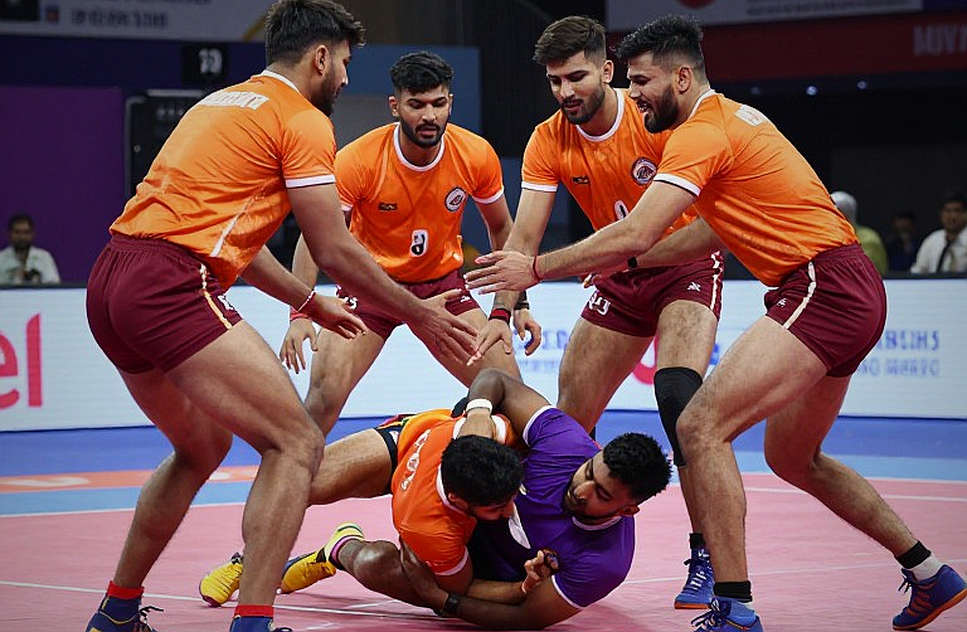
Treating 6,400 registrations as proof of popularity is the easiest trap in this report. That number measures supply, not demand — how many boys are sitting ready for one ticket. In Haryana kabaddi has never been only a sport; it is a route to a government job, railway and police first, a league contract now. Eleven weeks on the Haryana-Punjab belt taught me that counting is the easiest thing and meaning is the hardest. In 2026, on a ground outside Rohtak, I met a women's circle-style side with no stipend and one shared set of shoes. Their count never appeared in any report. A league that does not reach that ground is only wider on paper.
One question appears nowhere in the report: who sanctions this league? The Amateur Kabaddi Federation of India, the International Kabaddi Federation, or a private promoter? What is the contract structure, the anti-doping protocol, the refereeing standard? Not one answer. That is not a paperwork gap, it is a career risk. If the league turns out to be unsanctioned and its name surfaces in national selection, the same captain who went for Rs 10 lakh is the first man exposed.
The conventional reading is this: eight teams to ten, a bigger purse, larger participation — a second pillar is rising under kabaddi. Write that fairly in one sentence, then ask whether the evidence contradicts it or merely complicates it. The expansion is real, the purse is real, and both are small. What matters is the timing. The league is growing in the season when the country's flagship competition has no camera. Call it gap-filling intelligence rather than emerging confidence — and intelligence, too, is a form of opportunism.
The second error could be mine: dismissing a small league as trivia. Remember the constable-raider in Rohtak whose salary had stalled through 2026. For him ten lakh or seventeen lakh is not a glittering number, it is simply a reason to walk back to the akhada at dawn. In Jakarta in 2026 what stayed with me was not the medal but the hush around it, and that hush is what told me what the sport stands on. A league that cannot deliver a broadcast can still deliver a living. A match played in silence is still a match.
Three things to watch from here, none of which will appear on a scoreboard. First, the PKL's new media deal, because it decides whether this league looks like it is rising next year or shrinking. Second, one clear statement on sanctioning, without which every player's eligibility stays under question. Third, a single broadcast agreement, which would reveal whether the expansion was funded by capital or by hope. A fourth will never make a press release: how many boys came back to that Sonipat ground the next morning. The training ground speaks first; the scoreboard only repeats what it heard.