
Kabaddi: A Sport Decided in a Single Breath, Now the World Is Learning It Too
कबड्डी एक संपर्क टीम खेल है जिसकी उत्पत्ति भारतीय उपमहाद्वीप में हुई। कोर्ट पर प्रत्येक टीम के सात खिलाड़ी होते हैं और रेडर को 30 सेकंड के भीतर विपक्षी पाले में जाकर कम से कम एक डिफेंडर छूकर लौटना होता है; रेड के दौरान लगातार 'कबड्डी' बोलना अनिवार्य है। बोनस लाइन, सुपर टैकल, ऑल-आउट और डू-ऑर-डाई रेड खेल के प्रमुख नियम हैं। कबड्डी 1990 बीजिंग एशियाई खेलों से आधिकारिक खेल है और महिला कबड्डी 2010 ग्वांगझू से शामिल हुई। 2014 में शुरू प्रो कबड्डी लीग ने खेल को पेशेवर बाजार और टेलीविज़न दर्शक वर्ग से जोड़ा। भारत और ईरान इसके प्रमुख अंतरराष्ट्रीय गढ़ हैं, जबकि बांग्लादेश, दक्षिण कोरिया, केन्या और इंग्लैंड में भी संगठित गतिविधियाँ बढ़ रही हैं। अंतरराष्ट्रीय कबड्डी महासंघ इसके वैश्विक प्रसार का निकाय है।
Kabaddi is that rare sport where strength, technique and breath are decided in the same instant. The moment a raider steps onto the mat and begins chanting 'kabaddi', the word itself becomes the measure of his endurance — the breath stops, and he is out. Seven defenders form a wall, thirty seconds set the clock, and a single lunge can turn the whole match. From mud fields in South Asian villages, the sport has travelled to professional leagues, television graphics, data analysis and multi-crore contracts.
The structure of the game looks simple, but the detail within it is extraordinary. Each side fields seven players. The raider must enter the opponents' half, touch at least one defender and return across the line. Touching the bonus line earns an extra point, but also carries added risk. If the raider is tackled, the defending side wins a point and the raider leaves the mat. If the defenders fail to stop him, he returns with a point. After three straight empty raids comes the do-or-die raid — score or you are out. Super tackles, all-outs and last-five-minute strategy together make kabaddi as mathematical as chess and as physical as wrestling.
The roots of kabaddi lie deep in the soil of the Indian subcontinent. Folk tradition connects it with the chakravyuh of the Mahabharata, where Abhimanyu entered a circle of seven warriors alone — though this is a popular analogy rather than verified history. In South India it was played as chedugudu, in eastern India as hu-tu-tu and in the north as kaun bada. Standardisation of the rules in the twentieth century gave it the shape of an organised competitive sport. The formation of the Amateur Kabaddi Federation of India and later the International Kabaddi Federation opened the route to playing across borders.
On the international stage, the biggest milestone has been the Asian Games. Kabaddi was included as an official sport at the 2026 Beijing Asian Games and has stayed on the programme ever since. Women's kabaddi was added at the 2026 Guangzhou Asian Games. The Indian men's team held near-total dominance for decades, but at the 2026 Jakarta Asian Games Iran beat India in the final and changed the history of the sport. That was the moment it became impossible to argue that kabaddi could belong to only one country. India returned to the top afterwards, reclaiming gold at the Hangzhou Asian Games.
But the sport's real rebirth came not from the Asian Games but from television. The Pro Kabaddi League, launched in 2026, rewired the economics of the game. Before the league, kabaddi players looked for stability in government service, the railways or the police. After it, a professional career became possible. Auctions, franchises, coaching staff, physios and analysts all became part of the ecosystem. Television brought the sport to household audiences and converted regional identities into team loyalties. A viewing audience emerged that knows players by name, remembers their statistics and reacts to every raid.
The most visible face of that change is player earnings. Where even a good player once lived on uncertain financial ground, leading raiders and defenders now reach contracts worth crores. Pardeep Narwal is recognised as the league's highest scorer, and his dubki raid became an idiom in kabaddi's vocabulary. Naveen Kumar made his mark at a young age with aggressive raiding. Rohit Kumar, Ajay Thakur and Manjeet Chhillar each anchored teams across different eras. Most importantly, defenders such as Iran's Fazel Atrachali proved that the league is not a platform only for Indian players.
Iran's rise is one of the most interesting stories in the sport. In Iran, kabaddi inherited the physical strength, grip and defensive discipline of wrestling and volleyball. The Iranian side initially played a defence-first game and gradually built proficiency in raiding as well. Its Asian Games victory and the success of its players in the league signalled the sport's global future. Organised kabaddi activity is also growing in Bangladesh, South Korea, Kenya, Poland and England. The development of a domestic league in England and efforts to popularise the sport in European countries suggest that kabaddi's boundary is no longer a single continent.
Women's kabaddi has taken a major leap in the last decade and a half. After it gained official Asian Games status in 2026, the calendar of international competition expanded. The Indian women's team has been a consistent medal contender, while the women's sides of Iran, Bangladesh and Nepal have made the competition tougher. At home, support for women players is still not at par with the men's game, but television broadcast and social media have opened a new route to recognition. For girls from villages, kabaddi is now becoming a practical path to higher education, employment and social respect.
Behind this bright picture, the challenges are considerable. The biggest is infrastructure. League broadcast reaches big cities, but talent still comes from open grounds in villages and small towns. Trained coaches, proper mats and injury management at school and college level are not available everywhere. Kabaddi is a contact sport — ankle, knee and shoulder injuries are common. At the professional level the need for sports science and rehabilitation has grown, and much work remains in this direction.
The second challenge is financial sustainability. A successful league does not guarantee a successful system. The season arrives once a year, and for the rest of it players have limited sources of income. Prize money in state-level tournaments is modest and sponsorship unstable. Many players are therefore forced to run a job and a sporting career side by side. Long-term expansion of the league, a permanent structure for a women's league and grassroots initiatives such as scholarships could address this.
The third major challenge lies within the mat itself — balancing the speed of the game with its rules. Under pressure from fast-paced broadcast, some rules changed, strategy became more aggressive and the scoring burden on defenders grew. The bonus line and do-or-die raid added excitement, but the beauty of defensive play also has to be preserved. Technology has helped here: video referees, accurate scoring and data-driven analysis have made the game more transparent. Teams now compile an opponent raider's habits, defenders' positioning and trends from the final five minutes. This is making kabaddi a more professional pursuit than ever before.
One distinctive quality of kabaddi is that it does not require prior knowledge to watch. In most competitive sports the viewer needs context, but kabaddi's rules are understood within minutes and then grip the attention completely. That accessibility is the strongest foundation for its global expansion. In countries new to the sport, the first step is usually school and club-level competition, from which national teams are built. The International Kabaddi Federation works on this basis, providing coaching and training support to new member nations.
Much of the debate about the future centres on the Olympics. There has long been a demand to include kabaddi in the Games. There are several obstacles — the breadth of global participation, uniform rules, competition format and making the sport suitable for television and online audiences. But even before any Olympic place is secured, the sport has built a global professional ecosystem on its own strength, which is remarkable in itself.
The most beautiful part of kabaddi's story is its democratic character. It needs no inheritance, no expensive equipment, no special court. An open patch of ground, seven players a side and one chanting raider — and the game begins. That simplicity carried it into homes across South Asia. The task now is to combine that simplicity with professional structure, so that the sport's social base does not erode and its players receive the respect they deserve.
A single thirty-second raid can sometimes decide an entire career. That is the power of this sport — it hides large stories inside small events. From the Asian Games to a small town ground, kabaddi repeats the same question in the same breath: will you face the challenge and return, or will you be caught in the circle? The answer is perhaps hidden in that very sound that lingers on the court along with the raider's breath.

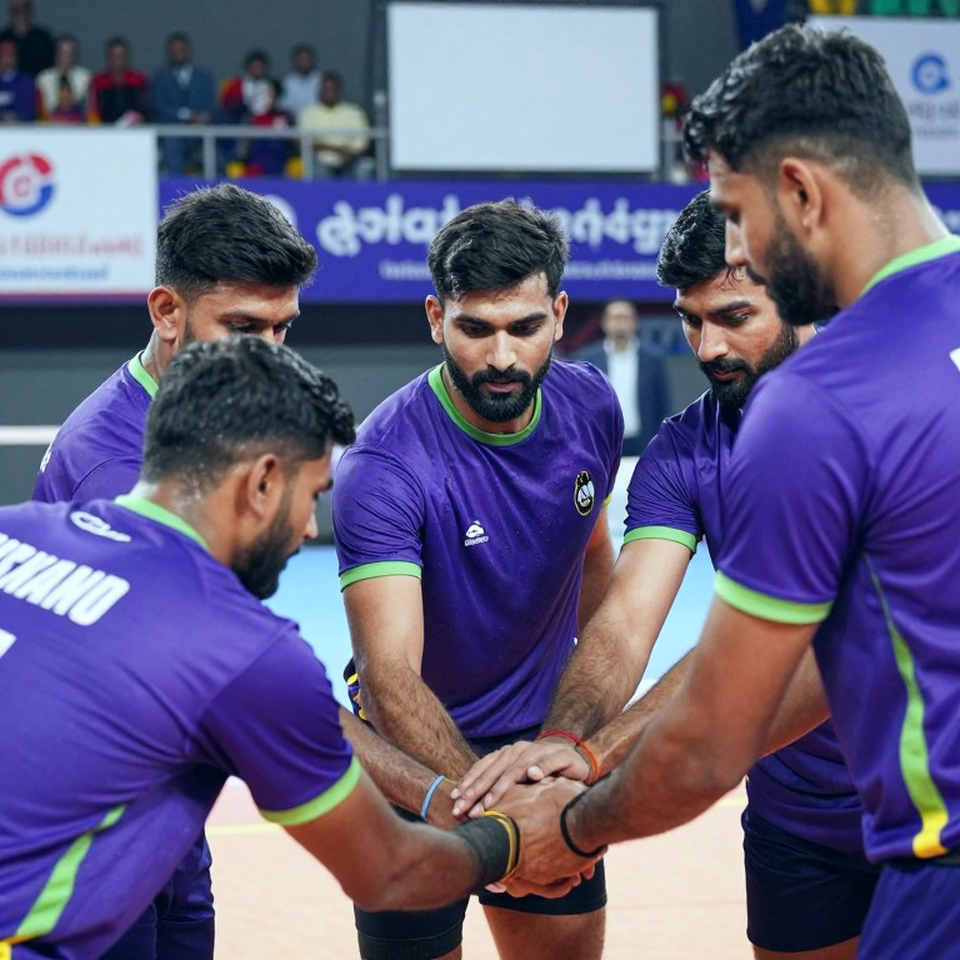
संबंधित खिलाड़ी
लोकप्रिय/पसंदीदा पुस्तकें
Commonwealth Kabaddi Championship: The 62-Match Schedule Has No Room for a Bronze Medal2026-11-10
The Gate Pass That Became a Raid Ledger: Three Kabaddi Truths the Scoreboard Never Tells2026-11-09
23 Teams, 62 Matches and Three Missing Countries: What Ahmedabad's First Commonwealth Kabaddi Championship Is Really Auditioning For2026-11-08
From 14 to 13: Pakistan's Withdrawal Is a Columns Story, Not a Commentary One2026-11-08
No Kabaddi Gets Played on an Empty Sheet: When the Data Pipeline Conceded Before the Match2026-11-07
Where and how to watch Commonwealth Kabaddi Championship 2026 for free in India? The answer is looking for you too2026-11-05
The Empty Frame: The Referee's Call That No Archive Remembers2026-11-01
अनुशंसित
The Real Story of the Mumbai Auction: When 12 Franchises Bought Reputation and Iranian Defenders Sold as the Cheapest Points2026-11-03
Commonwealth Kabaddi Championship 2026, Day 1: The Scores Are Honest, the Table Is Not2026-10-27
The Third Raid, Thirty Seconds and a Ledger: Where Kabaddi's Real Scoreboard Is Written2026-10-25
India vs Uganda: The real story is the 26 India conceded, not the 46 they scored — and a question over the 'Asian Games 2026' line2026-10-30
Commonwealth Kabaddi Championship: 62 Matches, Nine Days, and a Fixture List That Is India's Real Opponent2026-10-30
Surjeet Singh Named India Captain, Naveen Kumar Deputy for Commonwealth Kabaddi Championship 2026 — and the Three Things the Announcement Never Said2026-11-09
अनुशंसित
What the Auction Sheet Left Out — A Three-Column Audit of Kabaddi's Retention Filings2026-10-25
Commonwealth Kabaddi Championship 2026: Where to Watch Free in India? Official Details Remain Unclear2026-11-11
A Rs 5 Crore Purse, a Rs 17.4 Lakh Top Bid: Reading the Haryana Kabaddi League's Expansion Through PKL's Broadcast Crisis2026-11-03
Night One in Ahmedabad: Five Scorelines, Three Teams Who Never Played, and a 'Commonwealth' Label That Keeps Iran Out2026-10-25
India vs England, Commonwealth Kabaddi Championship 2026 Match 4: Read the Tape and the Minutes, Not the Scoreboard2026-10-25
Ahmedabad's New Geometry: At the Commonwealth Kabaddi Championship, India's First Contest Is the Draw, Not the Mat2026-11-10
अनुशंसित
Commonwealth Kabaddi Championship: The 62-Match Schedule Has No Room for a Bronze Medal2026-11-10
Commonwealth Kabaddi Championship: India's 127 Points Aren't the Story — England's 26 Are2026-10-27
India vs Uganda, Match 9: The Commonwealth Label, the Missing Iran, and the Half-Truth of 46-262026-10-25
From 14 to 13: Pakistan's Withdrawal Is a Columns Story, Not a Commentary One2026-11-08
Commonwealth Kabaddi: India's 46 Points Matter Less Than the 26 They Conceded2026-10-25
A Rs 5 Crore Purse, a Rs 17.4 Lakh Top Bid: Reading the Haryana Kabaddi League's Expansion Through PKL's Broadcast Crisis2026-11-03
Three Zones and One Blueprint: The Architecture of Pressure in Kabaddi, and the Silence in Its Numbers2026-10-24